The physics, in plain terms
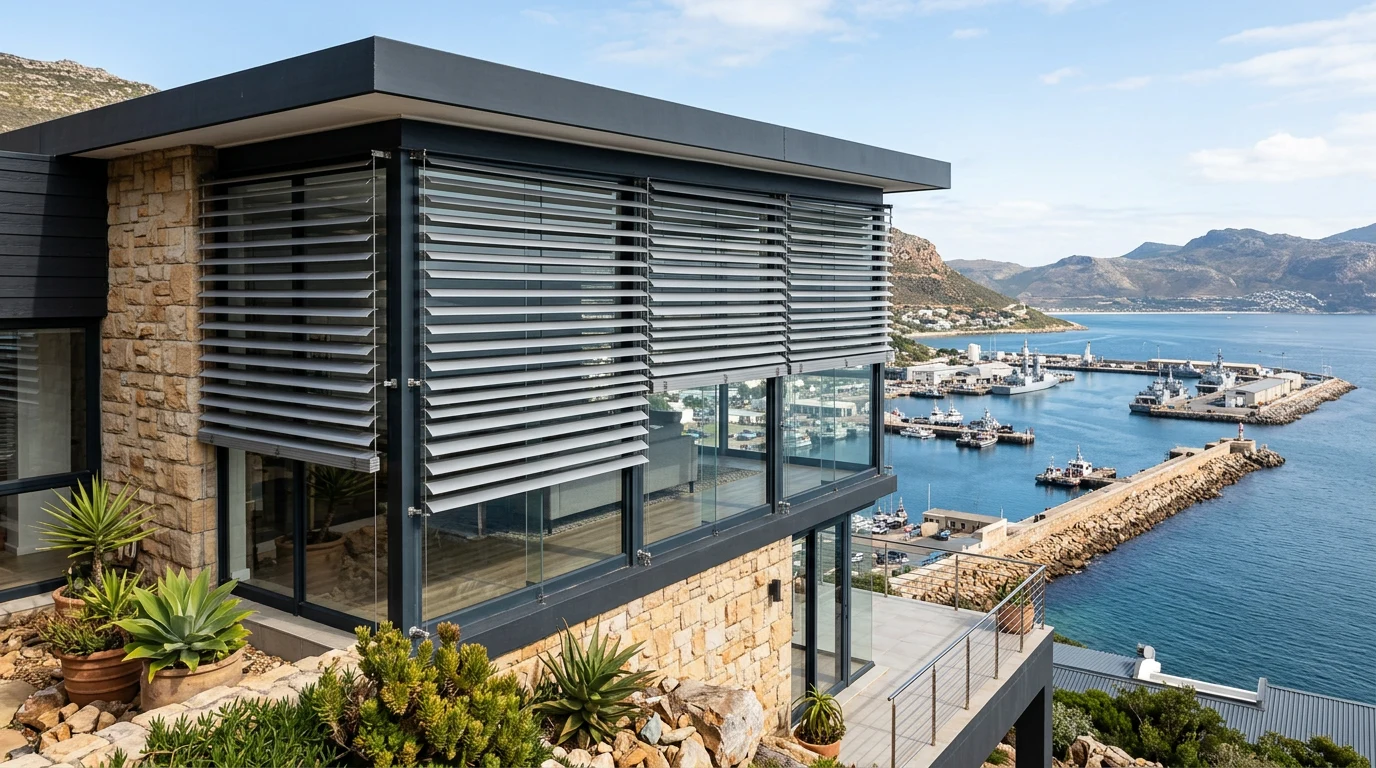
An interior blind manages heat that’s already inside the room; an external venetian stops most of it at the glass. On the newer cantilevered, glass-walled builds up the slope behind St George’s Street — the ones with a full-height window straight onto the naval base and the breakwater — that difference is dramatic rather than theoretical, and it’s how architect-led renovations elsewhere in the Cape handle a similar amount of glass.
Product reality
Wide slats (60–90mm class) run in guided side rails or cables, tilting and raising like an interior venetian but built for weather exposure. They’re effectively always motorised, and a wind sensor for automatic retraction isn’t an upsell here — it’s the responsible spec for anything hung outside on this coast. Finishes are powder-coated for the harbour’s salt air.
Why Simon’s Town homes ask for this specifically
Because the bay’s calm water throws its hardest glare in the morning straight at east-facing glass, and a big picture window can't simply be curtained without losing the view it was built for. Stopping that light at the facade rather than inside the room is the only way to keep the harbour visible and the room comfortable at the same time. Estate-style aesthetic committees aren’t a factor on most Simon’s Town stands, but a heritage-fronted elevation may still want a check before an exterior fitting — see our note on that under how we specify.
Honest limitations
This is a premium spend, positioned as a building improvement rather than window dressing, and it changes the look of the facade — worth discussing with a heritage-fronted property before committing. It isn’t a retrofit for every elevation either; fixing points and, ideally, planning at design stage make the difference between a clean install and a compromised one, which is exactly what the free measure is for.
Where else on the coast we fit this
The same logic applies to the large glazed walls on Kommetjie’s newer architect-built beach houses, and on the valley-view glass we shade in Noordhoek’s beach-modern homes below Chapman’s Peak.
What external venetians cost
The premium answer for an elevation that takes the sun square on, priced accordingly: manually run, R3,000 to R4,500 per square metre with fitting included, and R4,500 to R6,500 per square metre motorised. The cost lies in the guide rails, the head box and the fixings and coatings specified to survive salt-laden air on an exposed coastal wall for years.
A wind sensor belongs in the specification rather than on a list of extras, and it is quoted as its own line so you can see it. Small openings carry a minimum charge. Ahead of any figure there are practical tests: the structure above the opening must take the load, there must be clearance for the rails, and on a heritage-listed frontage whether anything may be fixed outside at all is a matter for the relevant authority rather than for us. All of that is settled at the free measure, and where an exterior system is not possible we quote an interior specification instead.
Do external venetians need a wind sensor?
Yes, as standard on our installs. An exposed external blind has to protect itself in a gust or a squall off the bay — the sensor retracts it automatically before that becomes a problem.
Can these be retrofitted, or only planned into a new build?
Retrofit is possible on a suitable elevation with the right fixing points, though a new build or major renovation gives the cleanest result if the facade can be planned around it from the start. We assess which applies at the free measure.